Discover the art in the permanent collection at the Donjon de Vez
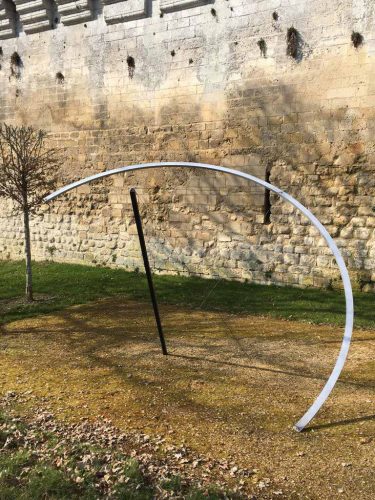
Patrick Fleury
Arc large
Outdoor parc
The artist Patrick Fleury was born in 1951. He divides space in order to give his work an internal-external dynamic. The wide arch adds a modern touch to the classic shape of a sundial.
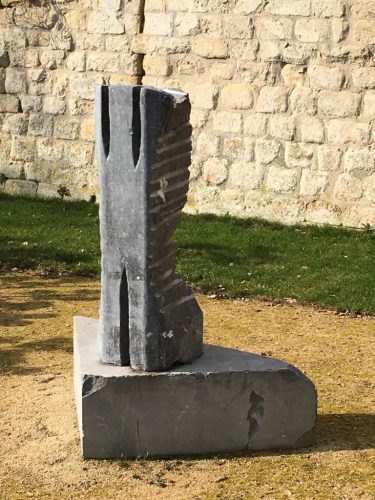
Eugène Dodeigne
Carré
Outdoor parc
The work of Eugène Dodeigne (1923-2015) shows a form of unity. Working in close contact with Constantin Brancusi, the artist felt very early in his career the need to transmit the energy of stone, its tension between surface and volume, which he developed in a range of expressionist figurative and uncompromising sculptures. With its clear-cut aesthetics and its sacral nature, Sans Titre (Untitled) (1997) can evoke a funerary monument from a primary civilisation, with a timeless presence and symbolic form.
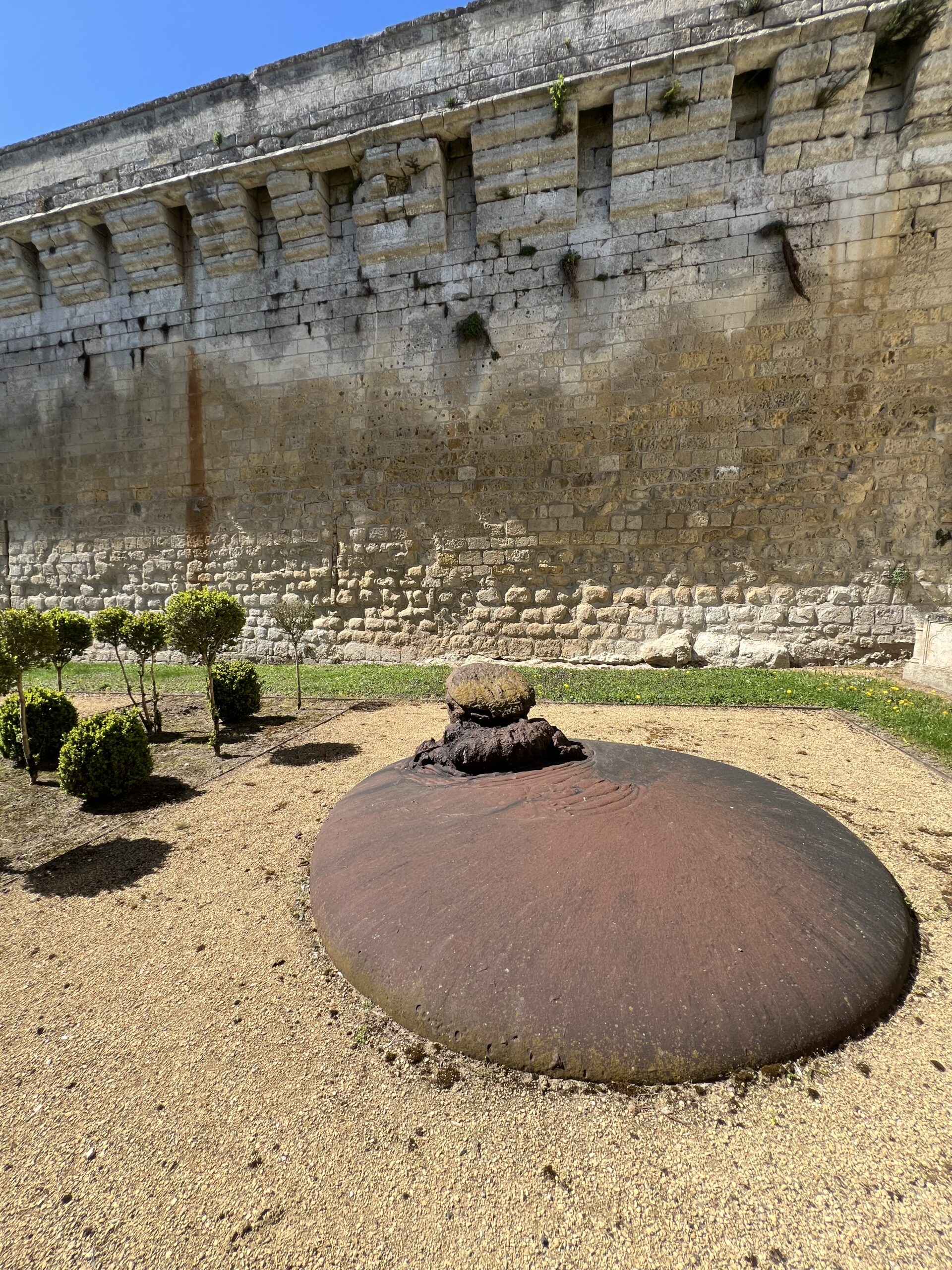
César
Expansion n°1
Outdoor parc
César (1921-1998) is famous for his work on Compressions, created with a hydraulic press, the chance result of a redesigned sculptural motion. His cast iron Expansions are less well-known, of which there are 6 unique pieces made in 1991. Expansion #1, Grosse ronde (Large round) is paradoxical, as it combines the softness of its round shape with the roughness of its material, its surface showing a telluric aspect due to rust. The randomness of the creative process is juxtaposed with that of the transformation of matter in time, which makes this piece simultaneously monumental and vivid.
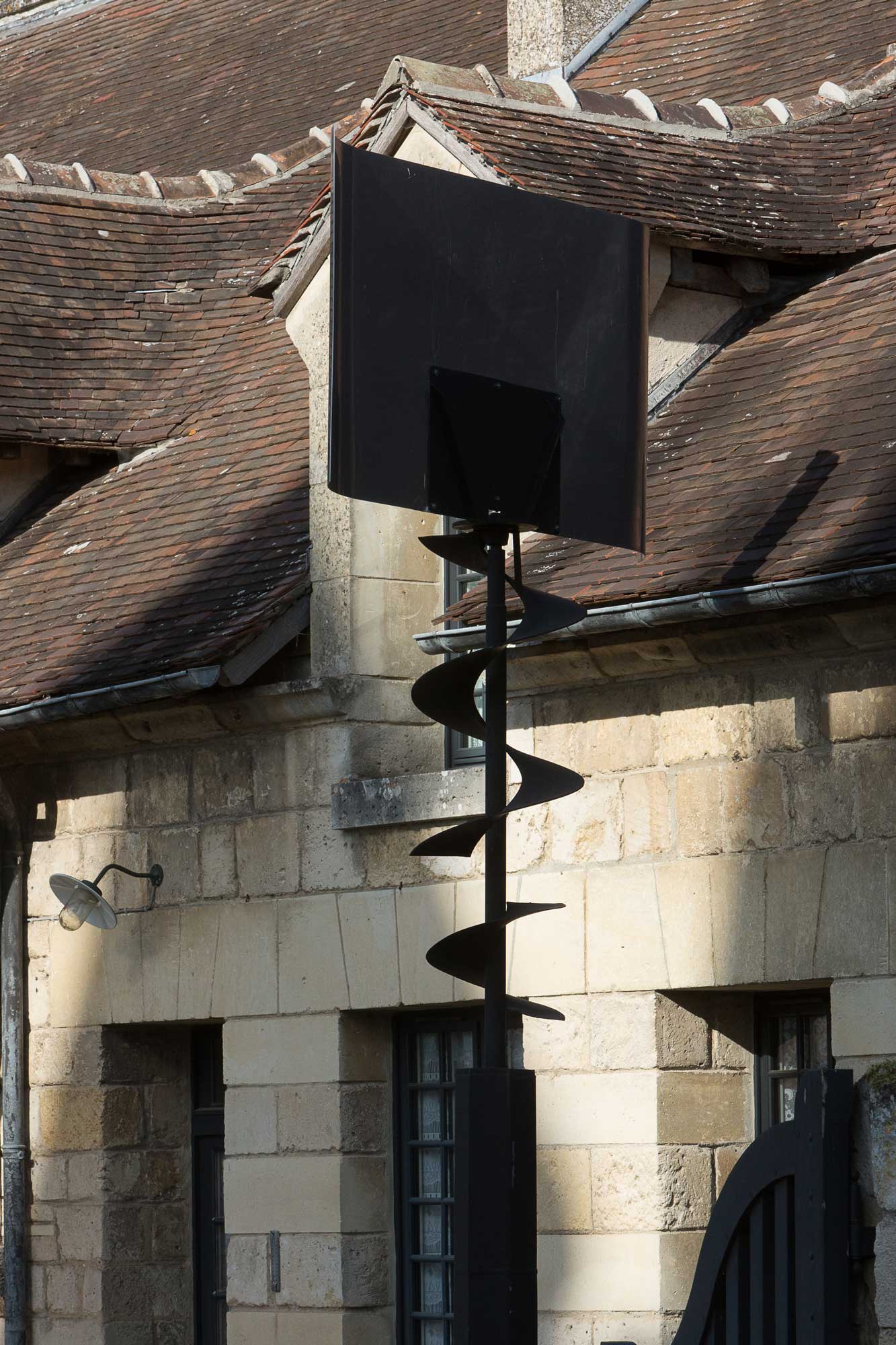
Vassily Takis
Éolienne
Antoine Bourdelle's Courtyard
The Greek artist Takis, who was born in 1925, showed early on an interest for kinetic art. His favoured research fields are wind, signage and magnetic fields.
The sculptures he creates are monumental and designed to interact with space, infusing oddity into landscapes. Reminding the viewer of both futuristic railway signals and totemic figures of another era.
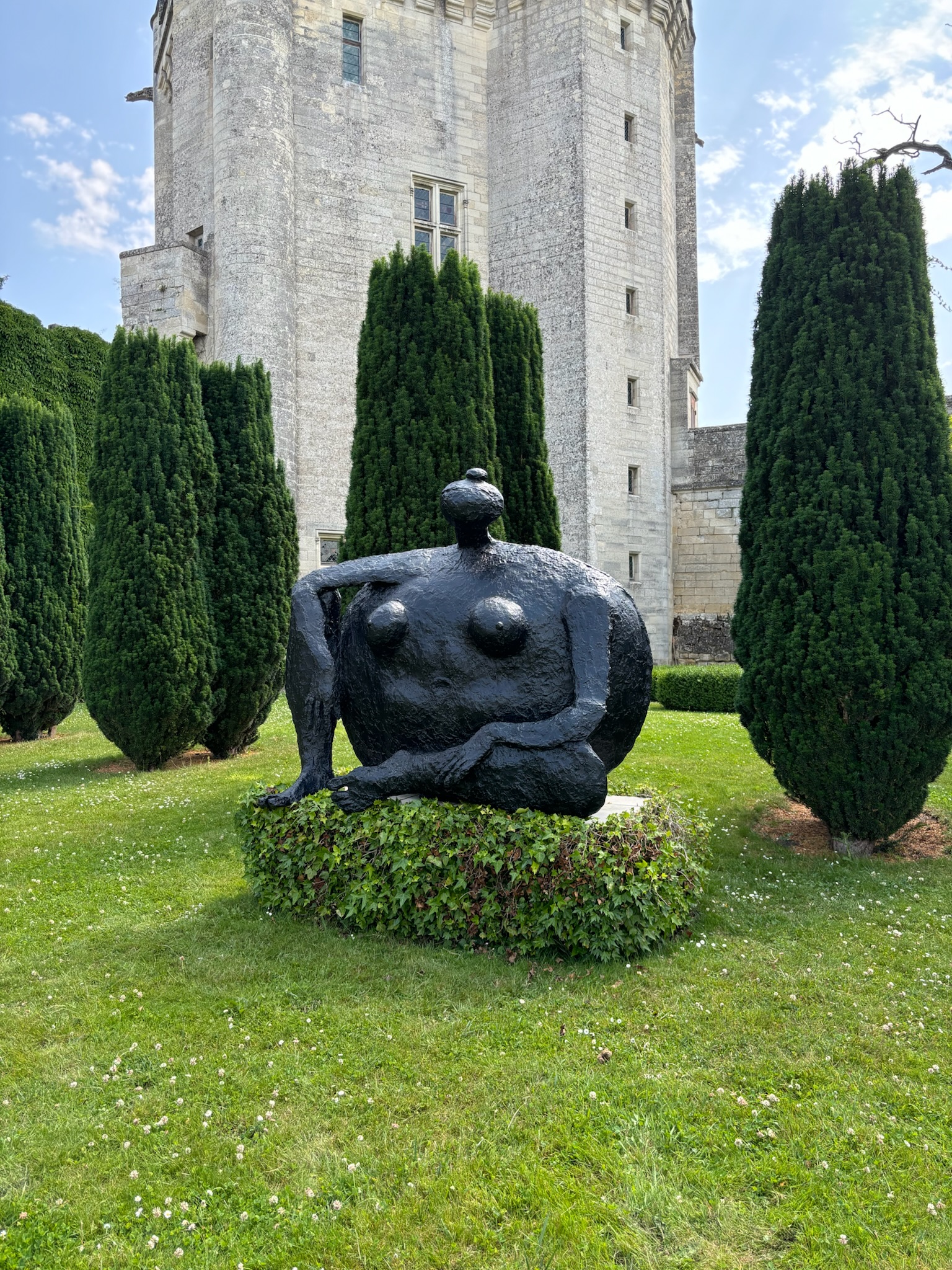
Robert Couturier
La Savonnette
Main Courtyard
La Savonnette is a bronze sculpture created in 1994 by French artist Robert Couturier (1905 – 2008). A student of Aristide Maillol, Robert Couturier's creations had full, round and generous shapes. After World War II, the artist tried to suggest rather than to represent. He preferred lines over actual shapes around the eternal theme of nudity.
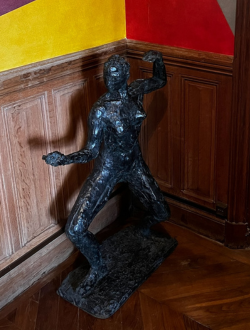
Germaine Richier
L'Ouragane
Chapel
Germaine Richier is one of the leading figures of the French sculpture of the 20th-century. Trained at the École des Beaux-Arts in Montpellier and later in Antoine Bourdelle’s studio in Paris, she developed, from a very early stage, an artistic style at the crossroads of figuration and modernity. Deeply affected by the Second World War, Germaine immersed herself in profound reflection on the human condition and sculpted powerful figures—hollowed out, eroded, almost damaged, sometimes hybrid—whose tormented material and rough surfaces convey both the fragility and the strength of the human being.
Laurent Grasso
Anechoic Wall
Donjon
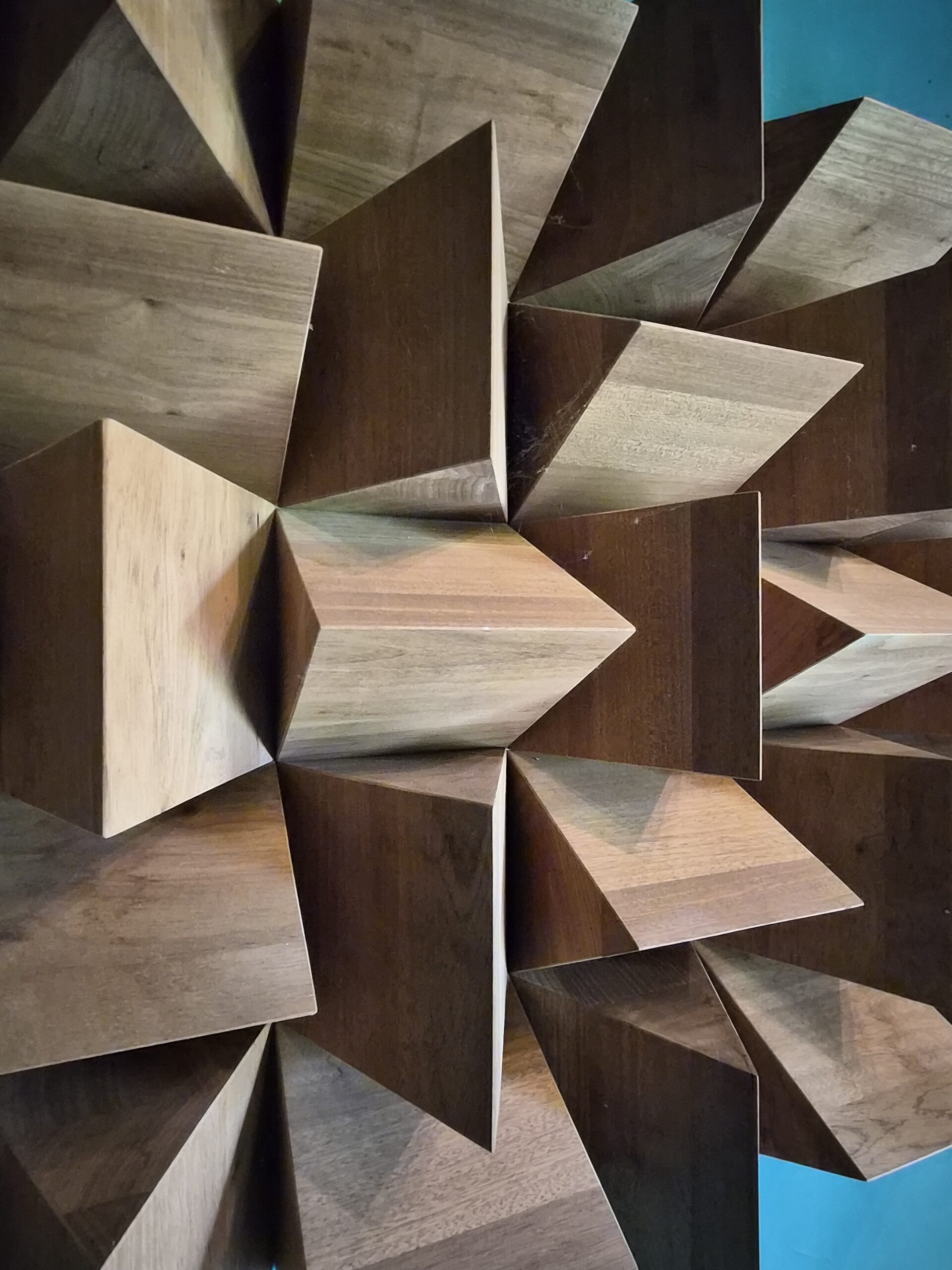
Laurent Grasso is a French contemporary artist who works with installation, video and sculpture. His work is often inspired by science, history and invisible phenomena, such as waves, fields or forces that we cannot perceive directly. He creates works that question our relationship with what we see, what we hear and what we think we understand.
Anechoic Wall is a wall sculpture composed of repeated geometric shapes, inspired by anechoic chambers. These spaces, used in scientific research, are designed to absorb sound or electromagnetic waves and eliminate all echoes. The wall therefore appears to both absorb and reflect: sound is evoked by its absence, whilst the surface captures and reflects light. The work offers an essentially visual experience, yet refers to sound and invisible phenomena.
Pablo Picasso
Donjon
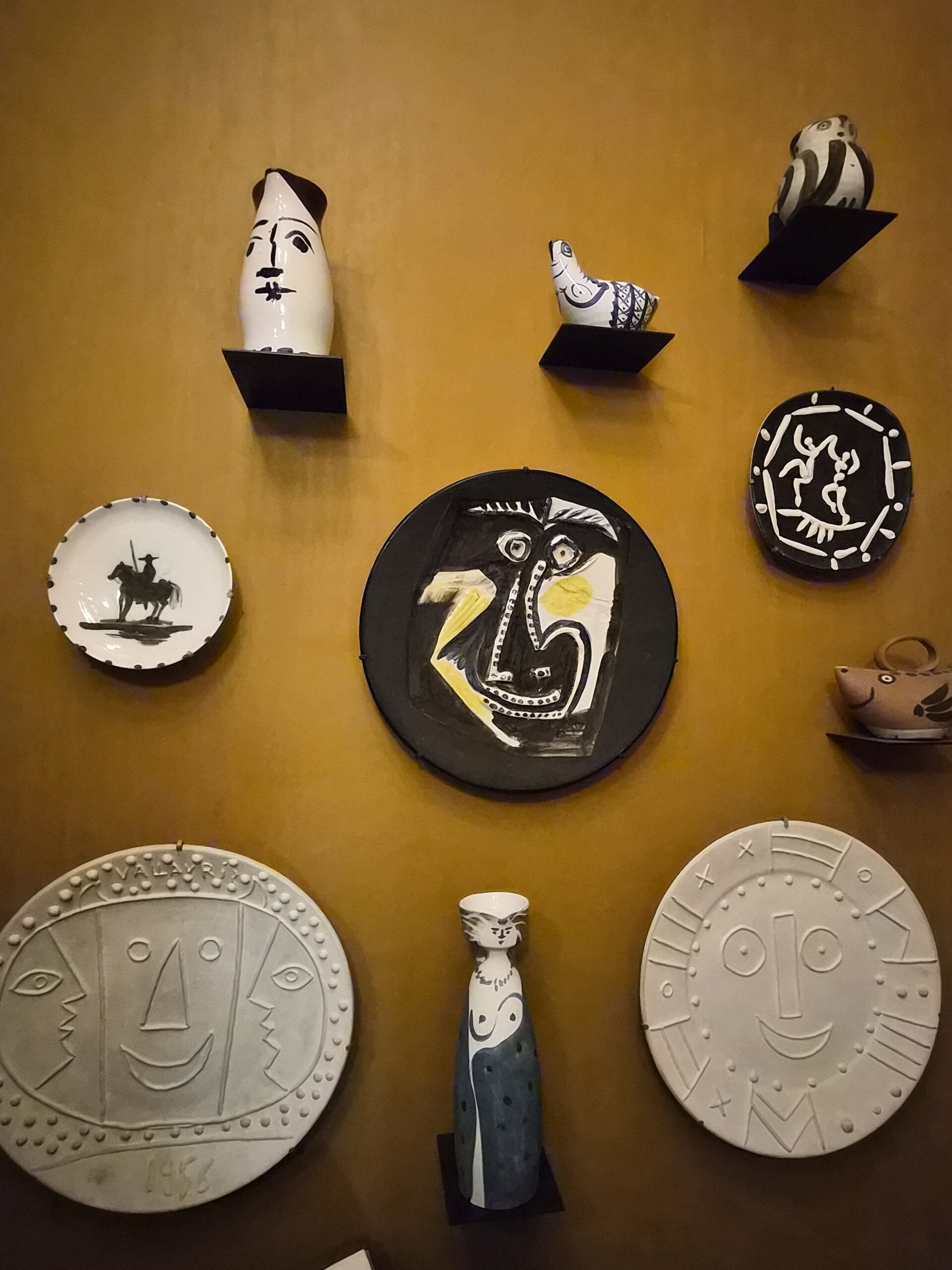
Pablo Picasso (1881–1973) was one of the leading artists of the 20th century. Famous for his paintings, he also produced sculptures, drawings and, from the late 1940s onwards, ceramics. Having settled in Vallauris, in the south of France, he discovered the Madoura studio. For Picasso, ceramics were not a minor art form: he applied the same free and inventive approach to them as he did to his other works.
The subjects depicted are simple and recurring: women, faces, animals, and scenes of celebration or dancing. The shapes of the objects (jugs, dishes, vases, mugs) often become an integral part of the design: a face follows the curve of a vessel, an animal transforms into an everyday object.
Among these themes, animals feature frequently. The owl, for example, appears in various forms: as a small sculpture, a jug or a vase.
Faces also occupy a central place: engraved, painted or modelled, the face becomes a distorted, assembled motif, akin to a mask. Other themes, such as the picador, drawn from the world of bullfighting, recall the artist’s Spanish roots and his longstanding interest in this subject.
Finally, Picasso regularly depicts movement and dance. The bodies are simplified and suggest rhythm or energy rather than a realistic scene.
Subodh Gupta
The Commons
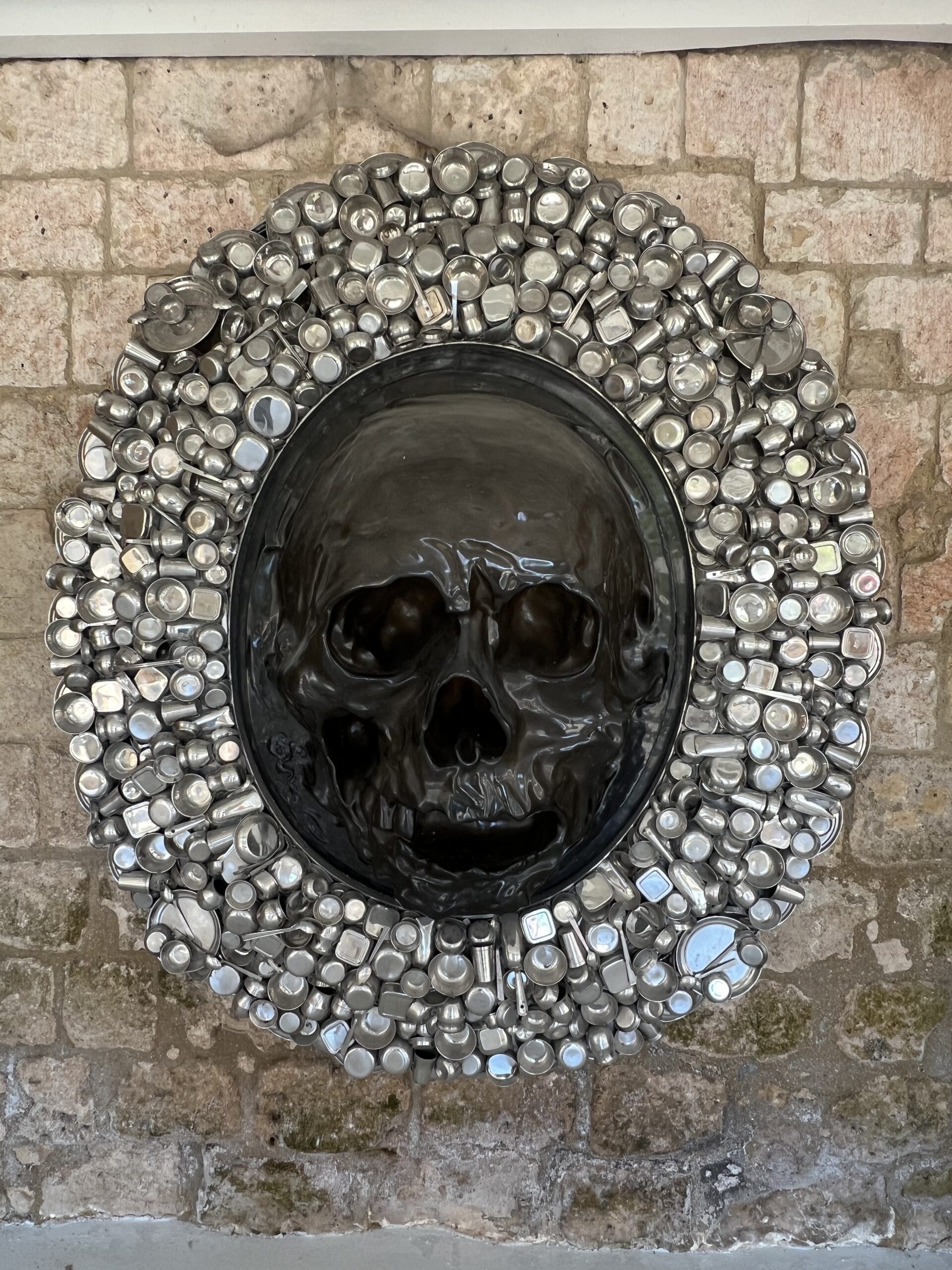
Subodh Gupta is a contemporary Indian artist. He is now one of India’s most internationally renowned artists. His work encompasses sculpture, installation, video and performance. He frequently uses everyday objects, particularly stainless steel kitchen utensils, which are ubiquitous in Indian homes.
Among his most famous works are several monumental skulls, including Very Hungry God (2006). The sculpture on display at the Donjon takes the form of a giant human skull, surrounded by several thousand assembled stainless steel utensils. From a distance, the work appears as a massive, gleaming skull; on closer inspection, the viewer recognises simple, domestic and familiar objects.
The skull is a direct reference to the memento mori, an ancient theme in art history that serves as a reminder of the fragility of life and the inevitability of death. But in Subodh Gupta’s work, this classical image is transformed: instead of precious objects, the artist uses everyday kitchen utensils associated with food, sharing and daily survival.
The materials chosen also reflect the artist’s personal and social history. The stainless steel utensils evoke Indian domestic life, migration, social inequalities, but also a culture undergoing profound transformation under the influence of globalization.
Hubert Le Gall
Bibliothèque S
The Commons
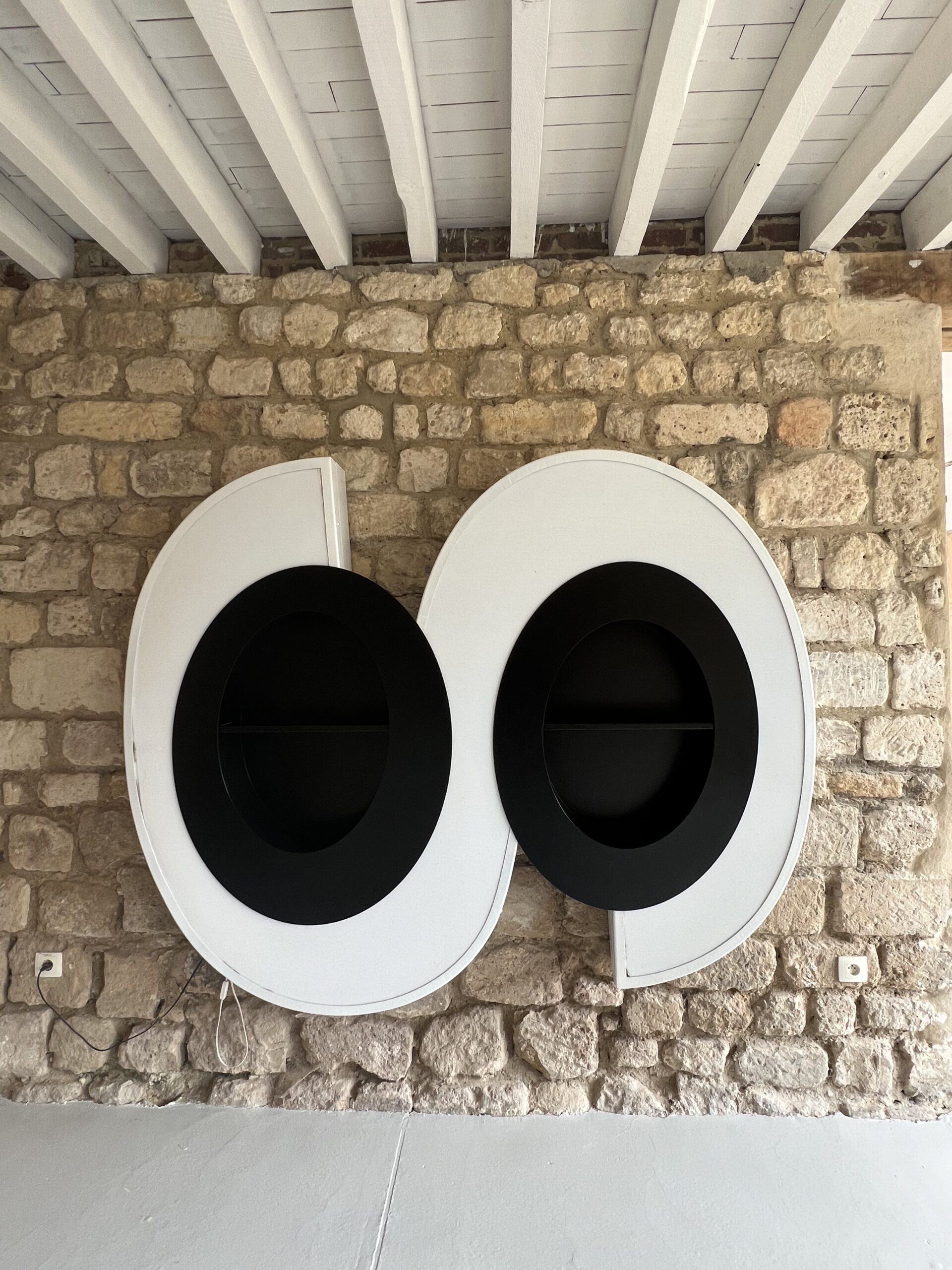
Hubert Le Gall is a designer, creator and contemporary sculptor, known for his creations that straddle the boundaries between art, furniture and interior design. His work often plays on sculptural form, elegance and a touch of poetry.
The piece presented here is a shelf that perfectly illustrates Hubert Le Gall’s approach: an everyday object becomes a sculptural element. The rounded, enveloping forms are as eye-catching as the storage function itself. For Le Gall, an object is never merely utilitarian: it contributes to the atmosphere and décor, and interacts with the space around it. This shelf can thus be seen as a piece of sculptural furniture.
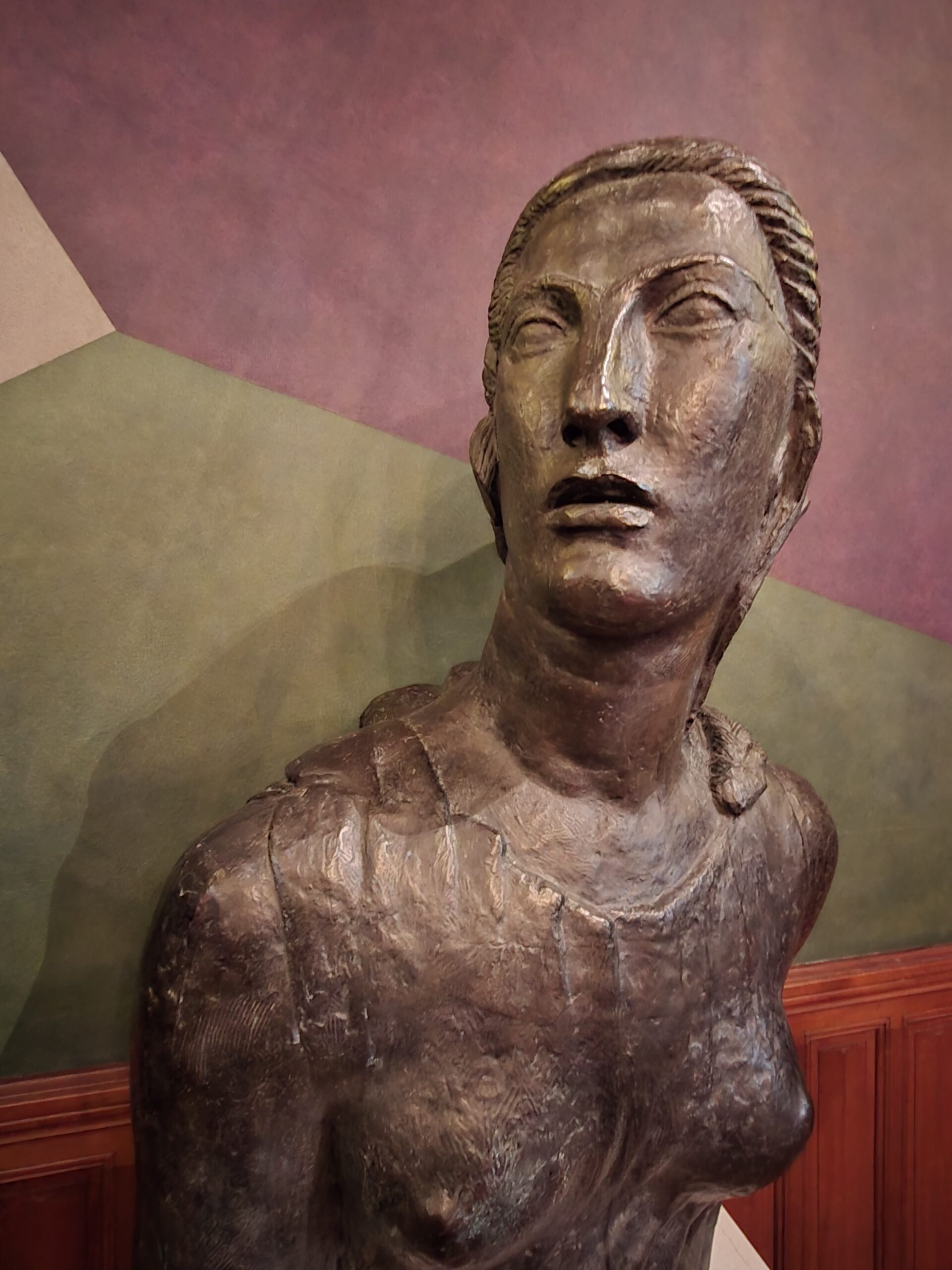
Antoine Bourdelle
La Victoire
Donjon
La Victoire embodies the style so dear to Bourdelle: a powerful, concise figure inspired by the great artistic traditions of Antiquity and the Italian Renaissance. Through its monumentality and the expressive simplicity of its forms, the sculpture perfectly illustrates Bourdelle’s ambition to reconnect with the heroism and grandeur of archaic art.
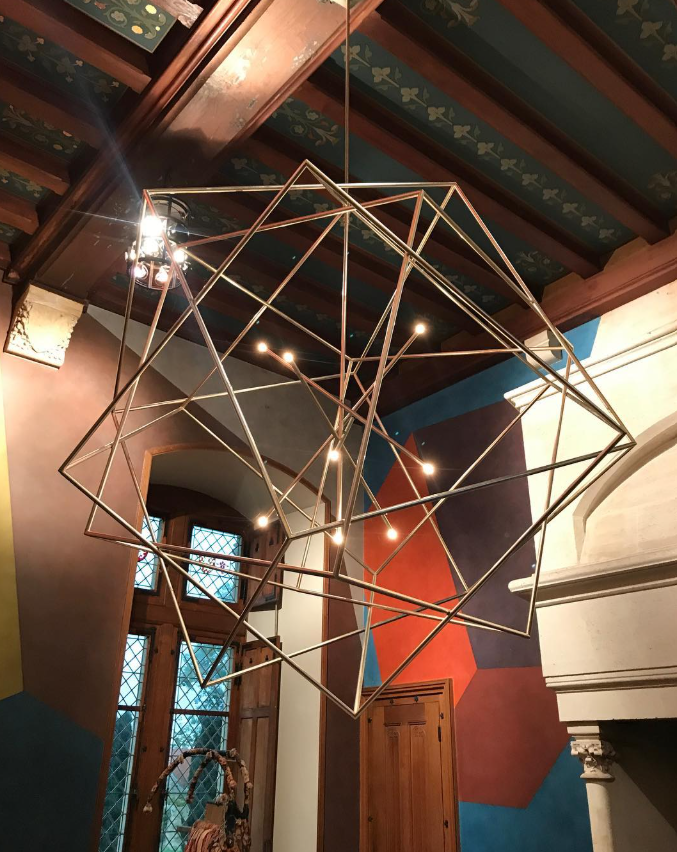
Hubert Le Gall
Polyèdres chandelier
Donjon
The Polyèdres chandelier is composed of slender metal rods assembled to form a light, geometric structure. The light highlights the lines and creates shadows that extend the form onto the walls.
This work echoes Sol LeWitt’s Wall Drawing: as with LeWitt, what matters most is the line and the way it defines the space. Here, the drawing is not on a wall, but in the air, in three dimensions. The chandelier is therefore not merely a lighting fixture: it is a suspended sculpture that transforms light into form and design.
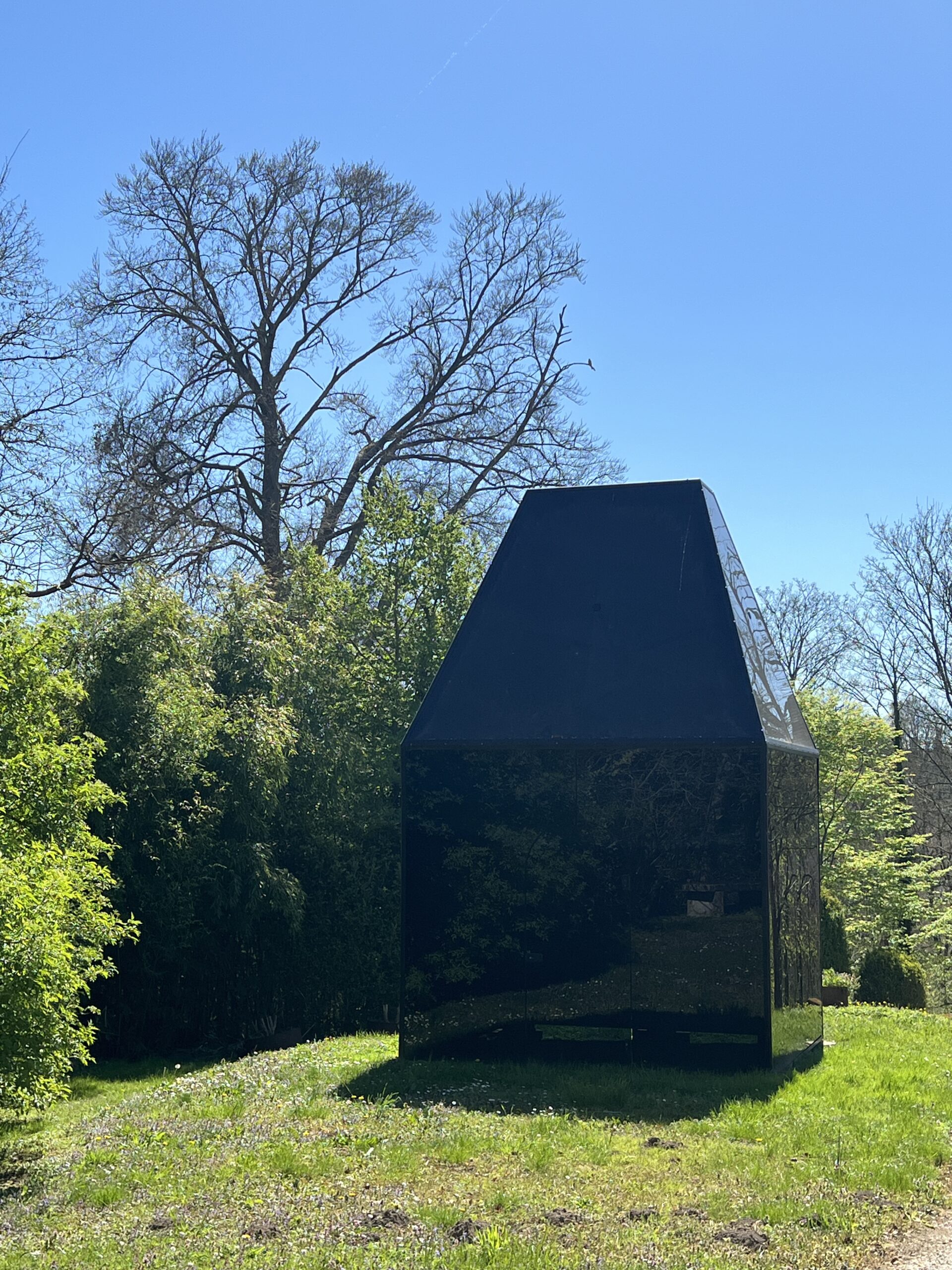
Odile Decq
Pavillon noir
Outdoor parc
With its proportions and silhouette, the pavilion echoes the architectural style traditionally found in castle grounds. It nevertheless creates a unique sensory experience: from the outside, the dark, mirrored glass reflects the surrounding landscape, giving the impression of a closed, enigmatic space. Conversely, once inside, this semi-silvered mirrored glass proves to be entirely transparent, blurring the boundaries between inside and outside and immersing the visitor in a direct connection with their surroundings.
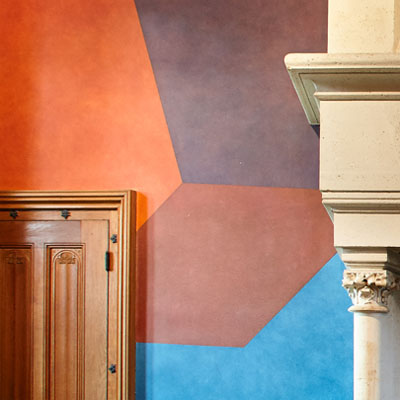
Salle « Sol LeWitt »
Le « Wall drawing »
Donjon
The large room on the Ground floor hosts a piece of work inspired by American artist Sol LeWitt, created in 1995, which is spread out on the four walls of the room. Sol LeWitt was born in 1928 in the United States, and disrupted the arts scene of the Sixties with a radical practice which aimed at stripping shapes and colours down to their simplest form. This stripping-down of shapes results in pattern geometrisation and by a tonal range limited to primary colours only. With his “Wall Drawing”, Sol LeWitt offers the viewer a series of geometric combinations that were reproduced.
Pascal Cribier
Jardin minimaliste
Main Courtyard
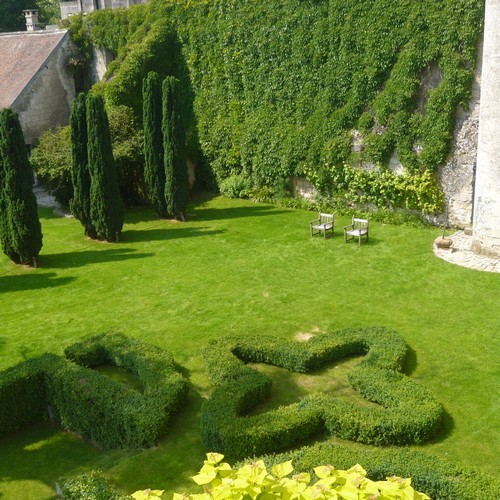
In 1990, the famous landscape designer of the jardin des Tuileries, Pascal Cribier, created for the Donjon de Vez a minimalistic garden exploring medieval iconography and the tradition of walled gardens. Quatrefoil plants, in the iconic shape of the Middle Ages, are combined with bunches of gaura, reminding the viewer of medieval “thousand-flower” tapestries. The organisation of the plants, based on a concept of levels, reminds us that during the Middle Ages, the notion of perspective didn’t exist, and simulation was obtained through volume variations and inverted heights. The French Ministry of Culture listed it as a“Remarkable Garden”. It is one of the few contemporary gardens to hold this title.
François Morellet
Ancienne cheminée
Main Courtyard
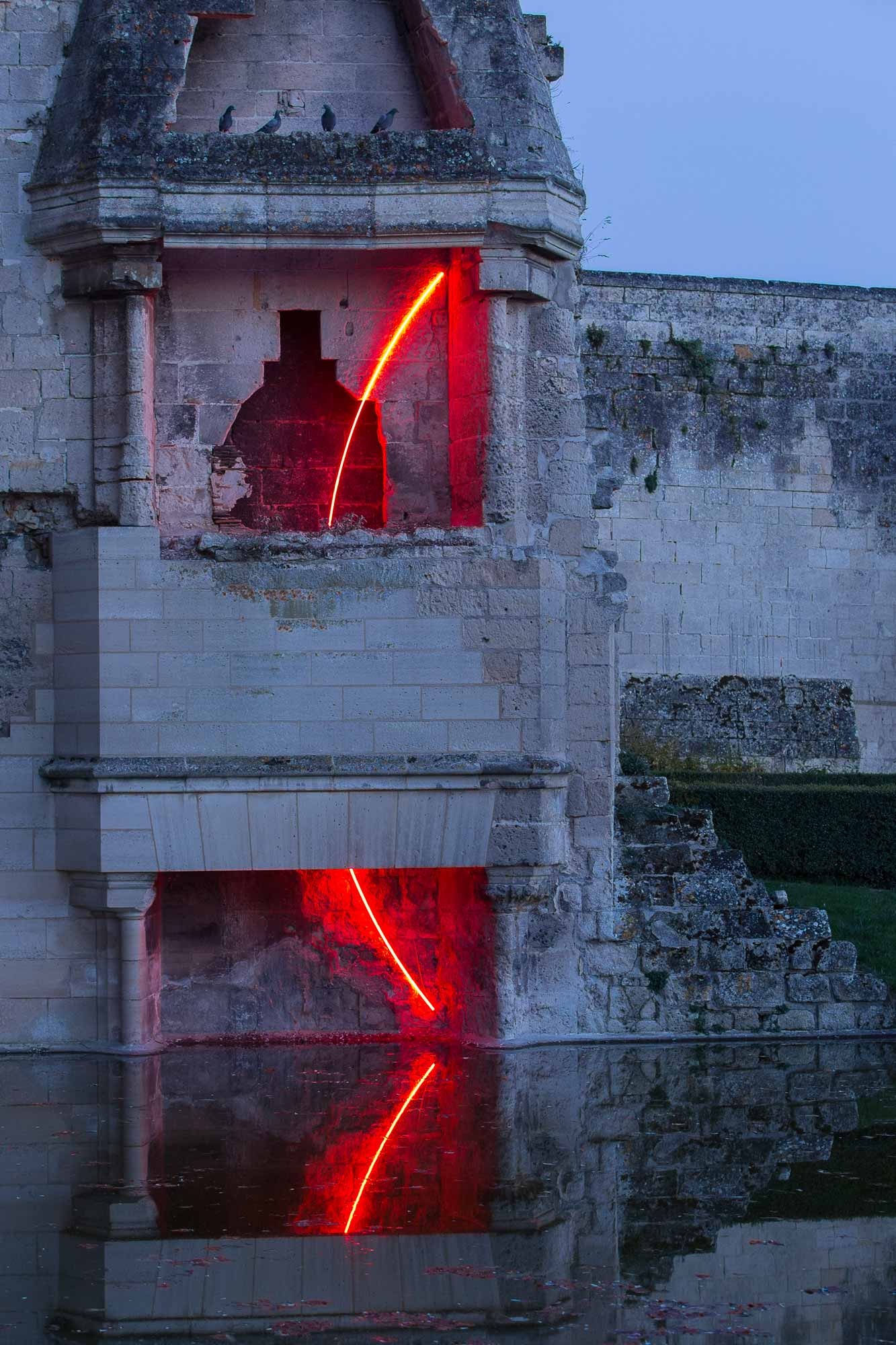
In 1999, François Morellet (1926-2016) created a minimalist work of art in the context of the « L’Art surprend l’éclipse » (Art surprises the Eclipse). This work is now exposed in the old chimney of the main building. Simultaneously a painter, sculpter and engraver, he also places neon lights to his works, playing with the lighting's intensity. A major figure of geometric abstract art and a precusor of minimalism, he was curious about the relationship between lines.
Jean-Pierre Raynaud
Pot or
Main Courtyard
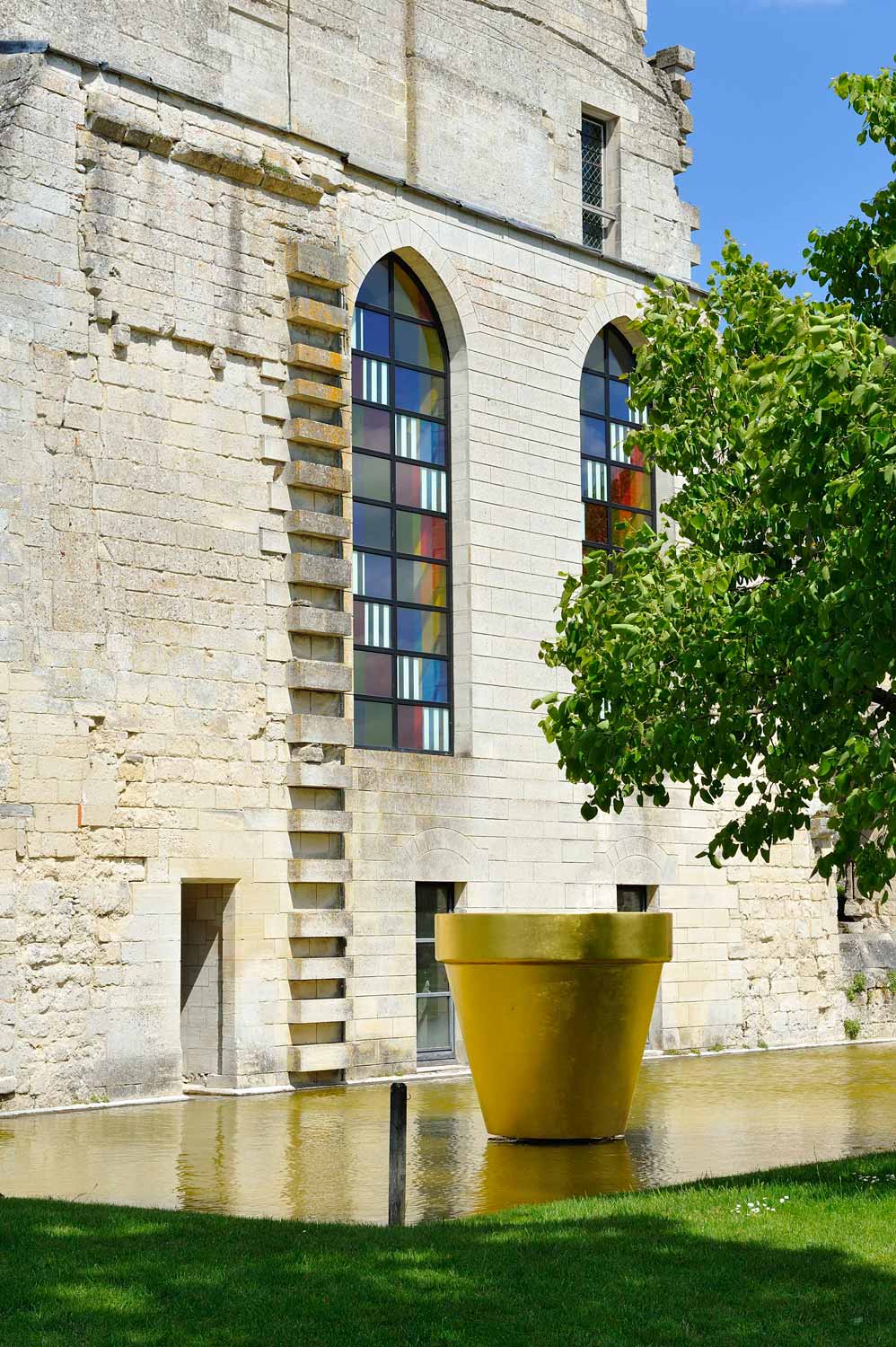
Behind the chapel, a water mirror creatively sets off the ruins of the old fortified house. Designed by Pascal Cribier, this layout allows for light to fluctuate with the sunshine, and is a prime venue for Jean-Pierre Raynaud’s Pot Or, a monumental sculpture covered in gold leaf. The artist, who was born in 1939, is also famous for his white faience ceramic works. Another Gold Pot, of larger dimensions, is currently exhibited on the terrace at the Georges Pompidou Centre in Paris.
Antoine Bourdelle
Allégories
Main Courtyard
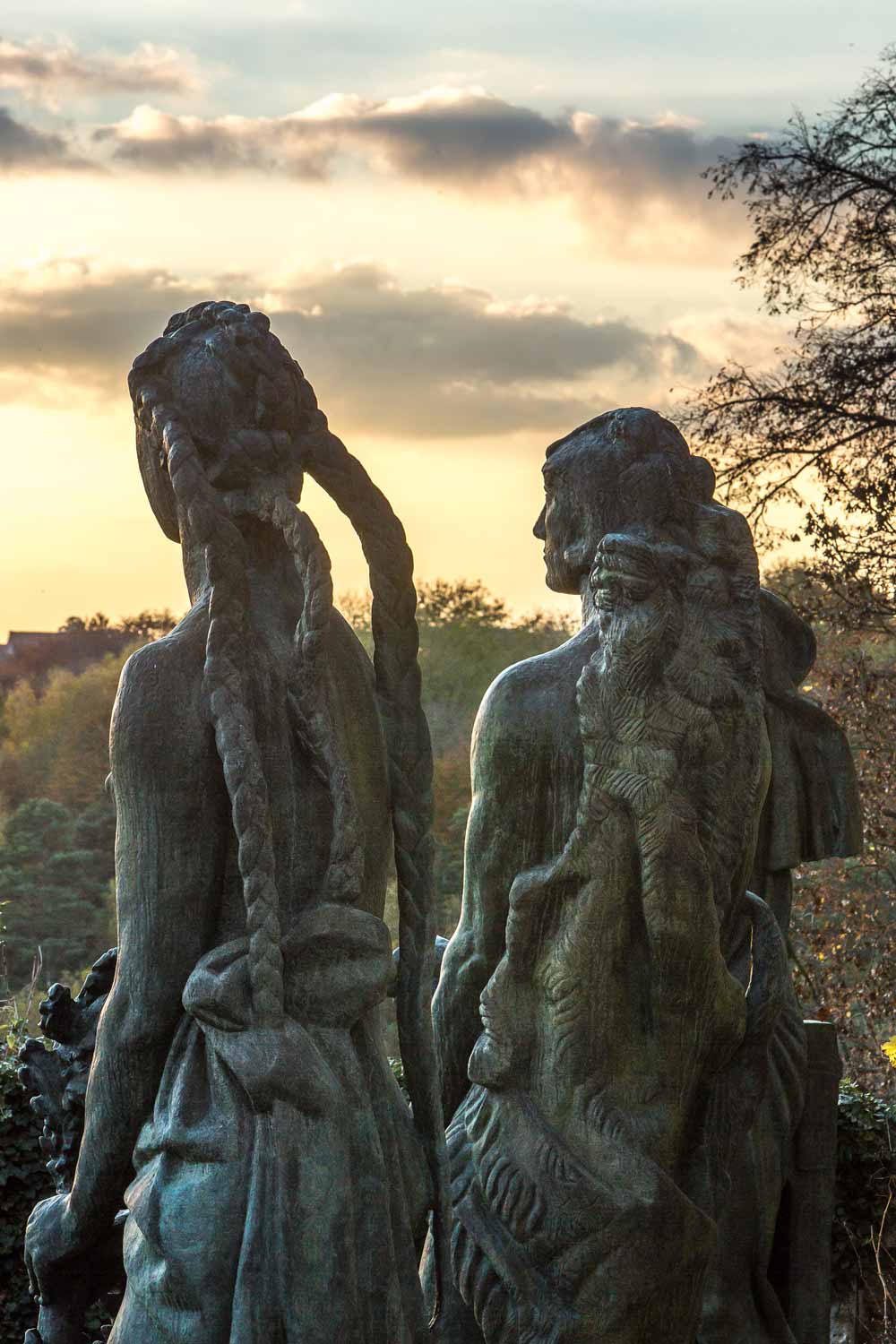
These three monumental bronze pieces by Antoine Bourdelle (1861-1929) evoke eloquance, strength and freedom. They were created for the statue of General Alvear in Buenos Aires. A student of Auguste Rodin and later teacher to Alberto Giacometti and Germaine Richie, Bourdelle's style is characterized by a need for order, harmony and measure inspired by ancient sculptures.
Daniel Buren
Verrières
Chapel
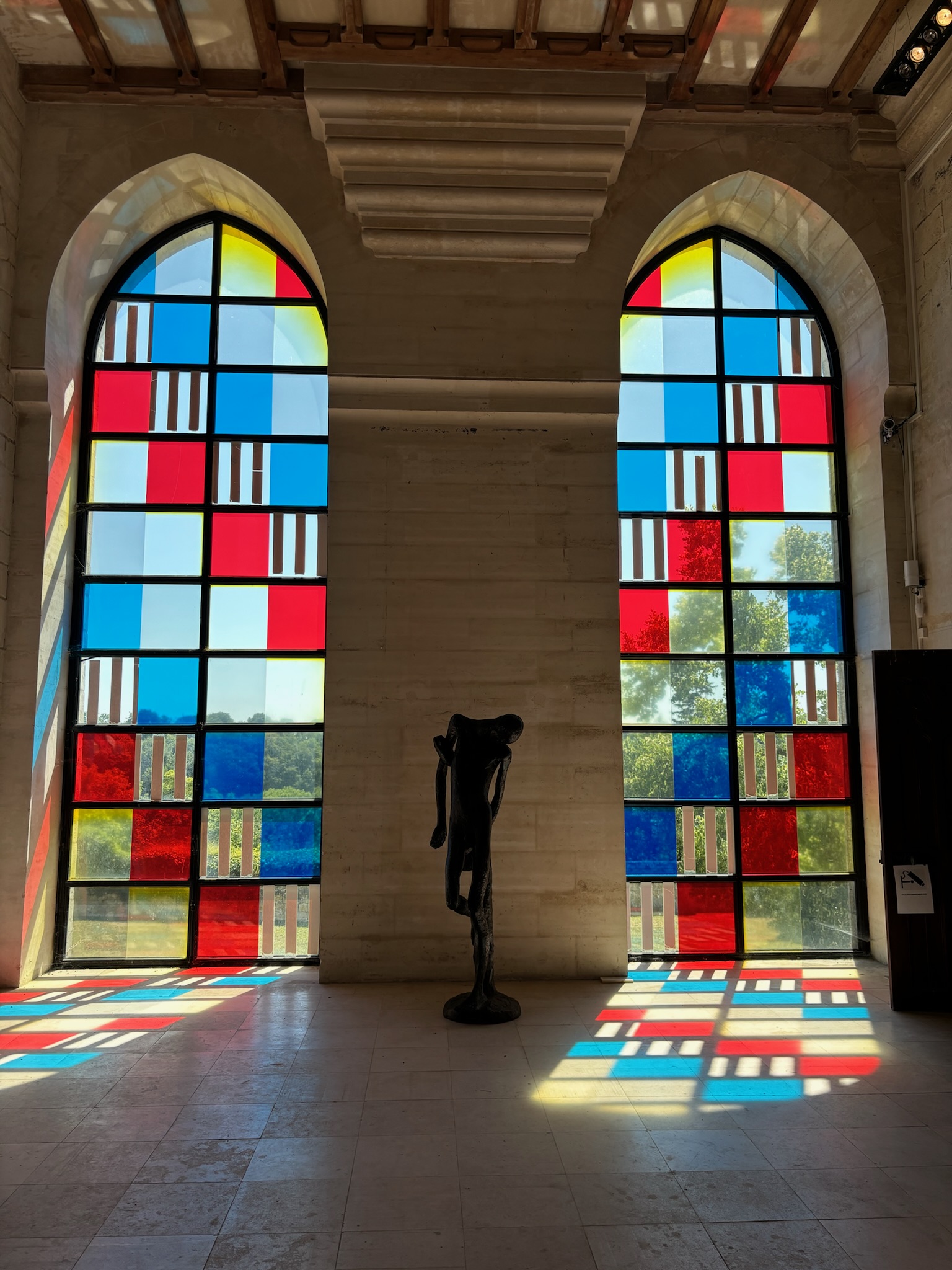
Daniel Buren was born in 1938 and founded the BMPT Group, with Mosset, Parmentier and Toroni in 1967. For their exhibits, each artist picks a pattern to be repeated. Buren chose alternating black and coloured vertical 8,7cm wide stripes. The viewer can find this aesthetic concept in this work of art, created especially for the Donjon chapel, in 2005. Working on the two large glass roofs, he offers an original perception of the place by playing with light and lines.
Emmanuel Frémiet
Gisants
Chapel
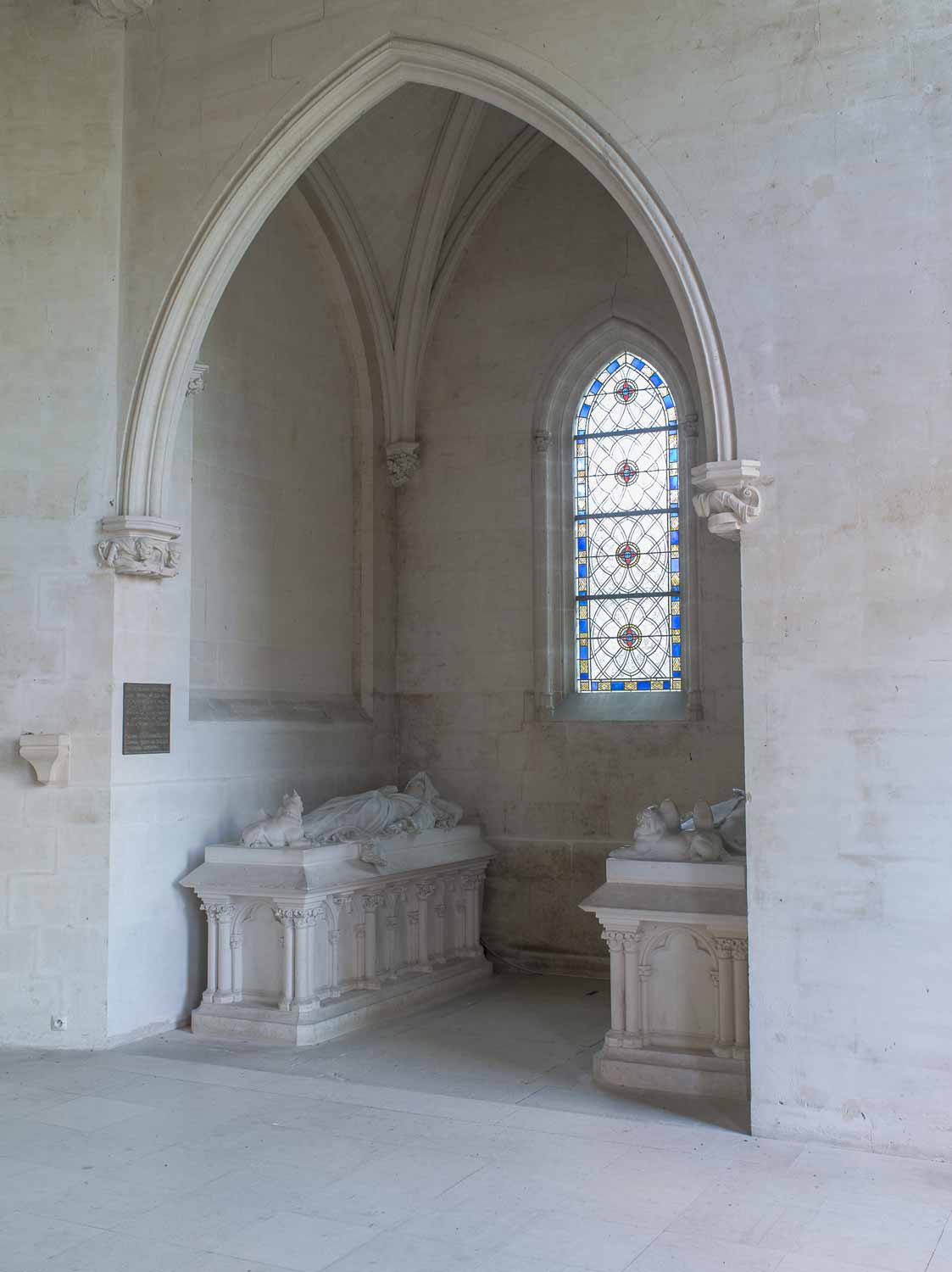
The white marble recumbent statues, graves of the previous owners of Vez Léon Dru and his wife, can be admired in the nave of the chapel. These installations by Emmanuel Frémiet, who was born in Paris in 1842, are a magnificent example of neo-Gothic sculpture. Emmanuel Frémiet mostly devoted his work to animal sculpture, but he also made a name for himself for State commissions. He is known for the first equestrian statue of Joan of Arc, erected Place des Pyramides in Paris, and also the sculpture of Saint Michael adorning the top of the steeple of the church of Mont-Saint-Michel.
Gustave Eiffel
Charpente
Chapel
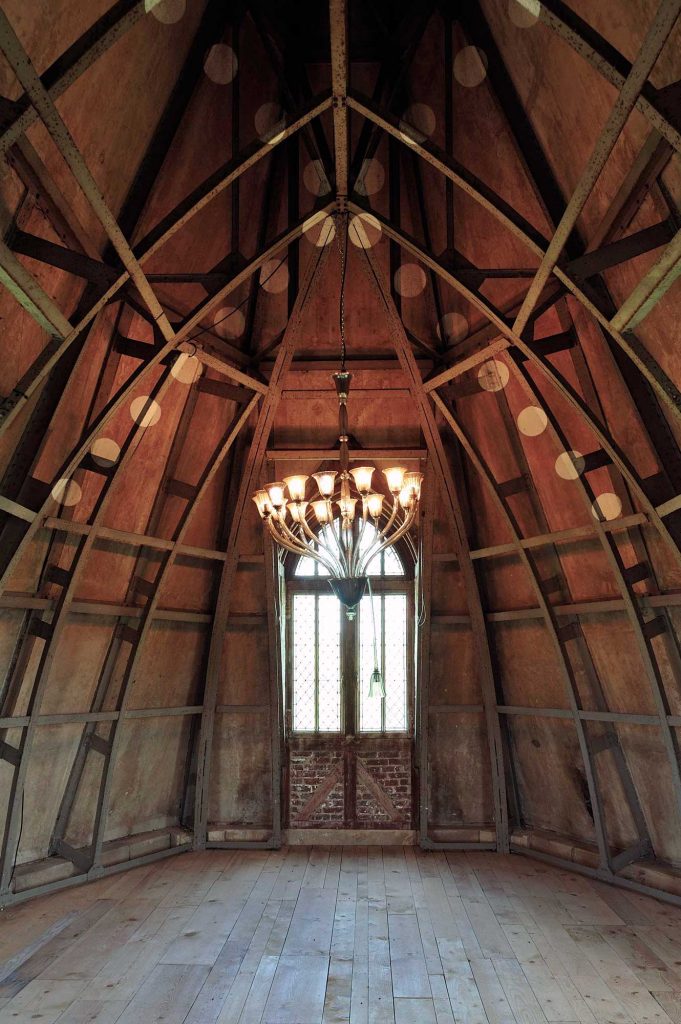
The Eiffel room, with its remarkable cradle-like framework, was designed by famous French engineer Gustave Eiffel and is a tribute to French civil engineering. This metal architecture is a reminder of the contribution of Léon Dru, a great civil engineering industrialist and former owner of the Vez castle, who restored the Donjon to its feudal character. Léon Dru was a patron or the Arts and Heritage, and contributed to the national collections, by donating two works by Chardin to the Musée du Louvre, and by assisting the State in purchasing the castle of Azay-le-Rideau.
Lee Ufan
Relatum X
Outdoor parc
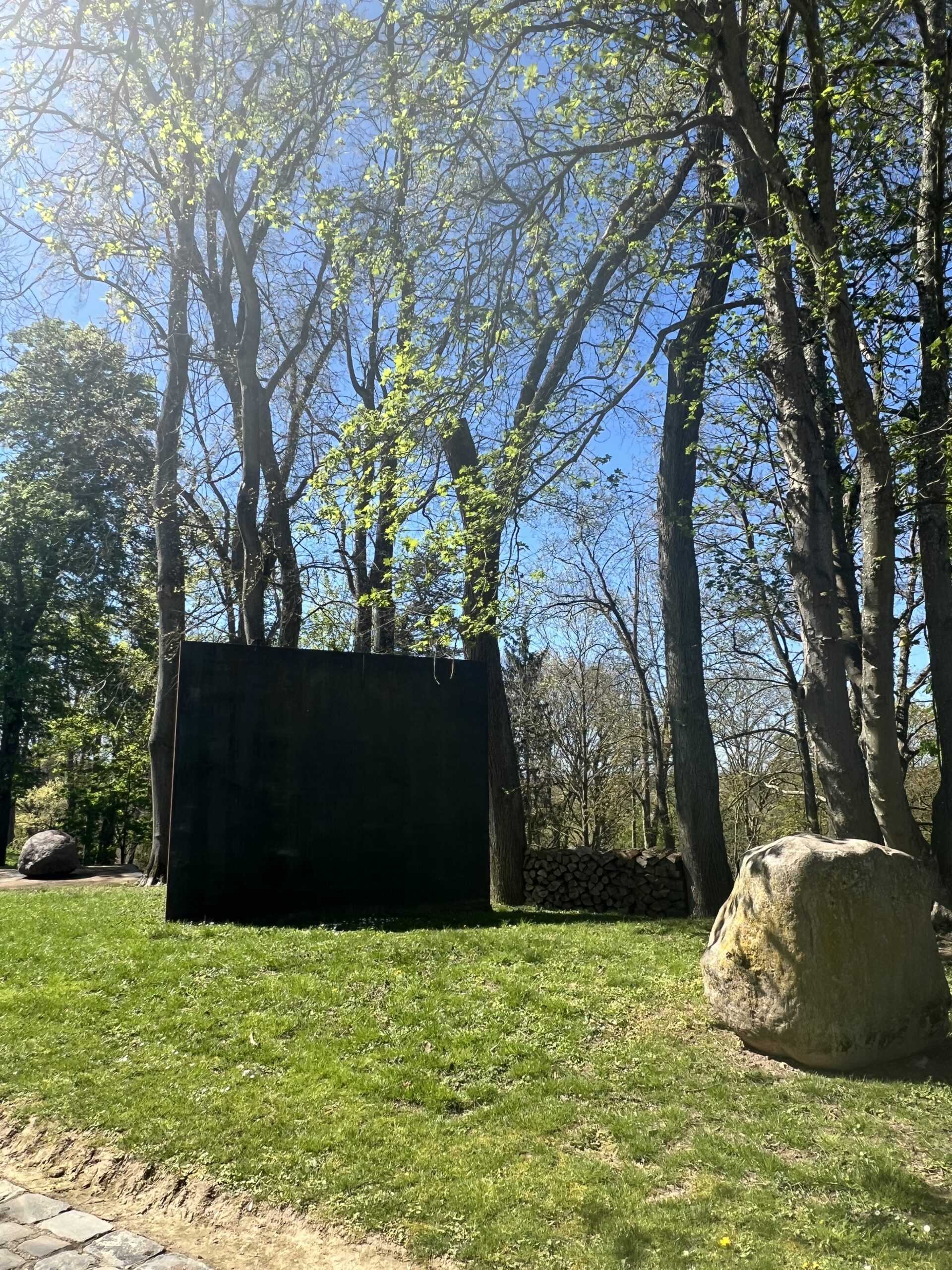
Since 2015, one year after his remarkable exhibit at the Château de Versailles, the Donjon of Vez has had the pleasure of hosting a piece of work from Korean artist Lee Ufan.
His vocabulary is misguidingly simplistic. This sculpture, like a dialogue between being and time, links nature to human awareness by the confrontation of the steel plate, metaphor of the industrialised society, and stone, symbol of nature.

Tadashi Kawamata
Cabanes
Outdoor parc
The lower courtyard, which originally held the stables and storage buildings of the castle, hosts nowadays an installation of Japanese artist Tadashi Kawamata. This artist, who was born in Tokyo in 1953 and is internationally renowned, has chosen wood for his favoured material. The in situ work is suspended in the trees and is emblematic of the work of the artist, who modifies our perception of the location through improbable constructions and invites us to experiment in a completely different way.
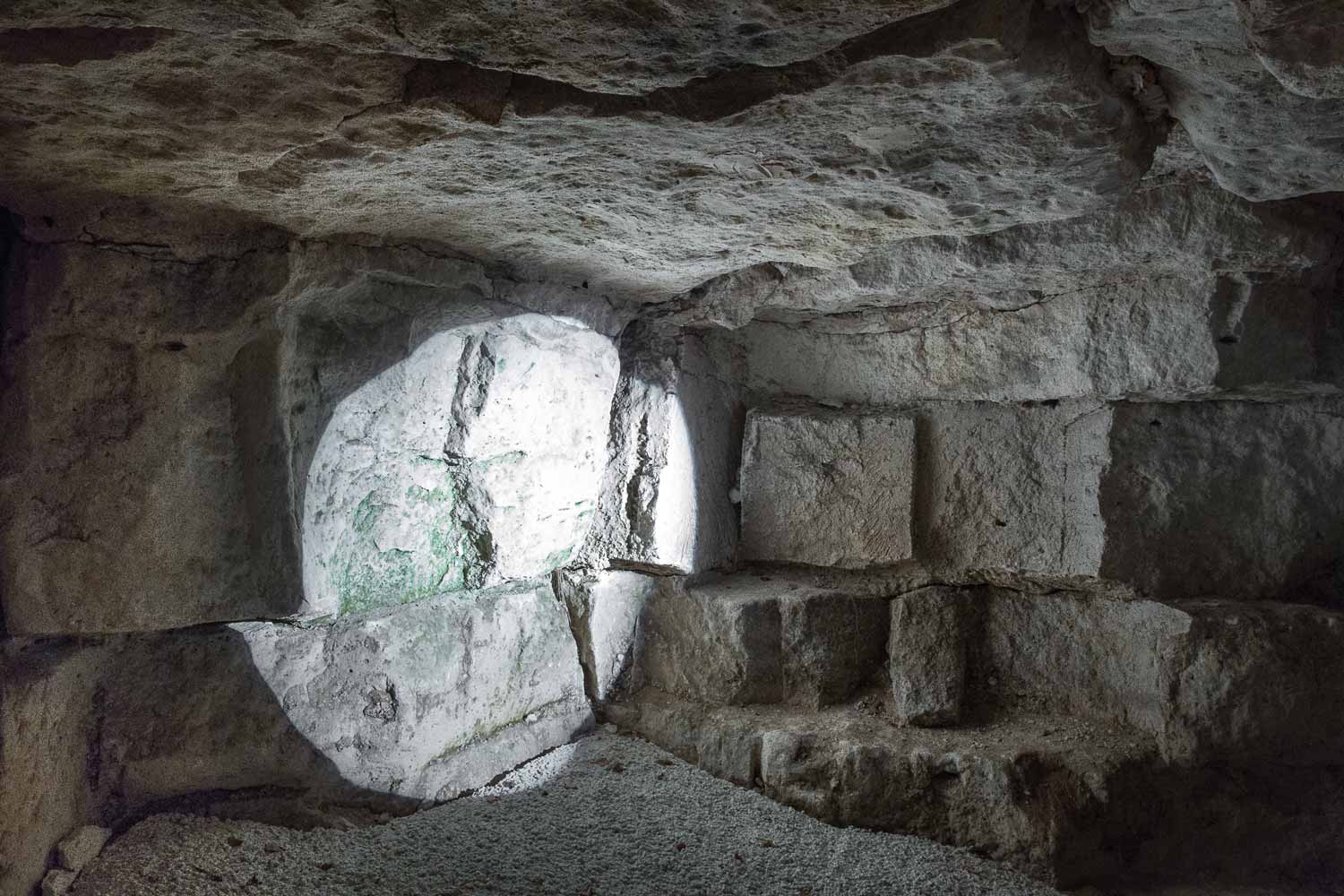
Michel Verjux
Underground galleries
The medieval underground galleries can be found below the lower courtyard. They were carved out of the stone, and were where the construction stones for the castle were extracted. French artist Michel Verjux created in March 2011 a luminous device at the heart of this tunnel. The artist was born in 1965 and developed a concept around the device, where light has a central place, focusing on the way things are shown, more than on the things themselves.